
Reading time: 3 minutes
Temporary numbness after wisdom teeth removal is expected while the local anesthetic wears off. If numbness, tingling, or changes in sensation continue beyond the expected recovery period, they may indicate irritation of a nearby sensory nerve and should be evaluated by your oral surgeon.
What Are the Symptoms of Nerve Damage After Wisdom Teeth Removal?
Persistent numbness or changes in sensation after the local anesthesia has worn off may be signs of nerve irritation. Permanent nerve damage is uncommon, but persistent symptoms should be evaluated by your oral surgeon.
Symptoms may include:
- Numbness in the lower lip, chin, tongue, or gums
- Tingling or pins-and-needles sensations
- Burning or increased sensitivity
- Altered taste on one side of the tongue
- Difficulty feeling hot or cold
- Reduced feeling in the affected area
Which Parts of the Mouth Can Be Affected?
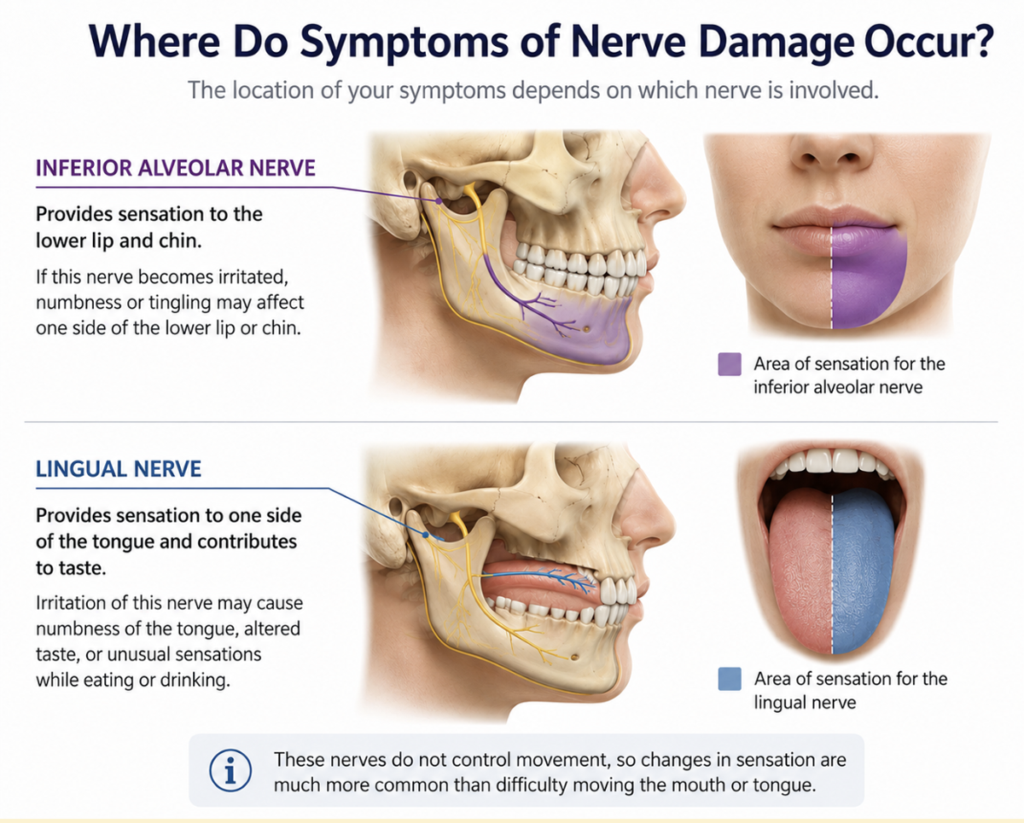
The location of your symptoms depends on which nerve was affected during surgery.
- Lower lip and chin: Numbness or tingling in the lower lip or chin is usually associated with irritation of the inferior alveolar nerve.
- Tongue: Numbness, tingling, altered taste, or unusual sensations on one side of the tongue may occur if the lingual nerve is irritated.
Changes in sensation are much more common than problems with movement because these nerves primarily provide feeling rather than controlling the muscles of the mouth.
When Is Numbness Considered Normal?
Immediately after surgery, numbness is expected because of the local anesthetic used during the procedure. Depending on the anesthetic, normal feeling usually begins returning within several hours.
As the tissues heal, it is also common to notice temporary tingling or mild sensitivity. These sensations are often part of the normal healing process and are different from persistent numbness that does not improve after the anesthetic has worn off.
If you are unsure whether your symptoms are part of normal recovery, contact your oral surgeon for guidance.
A Different Approach for Wisdom Teeth Close to a Nerve
When a lower wisdom tooth is extremely close to the inferior alveolar nerve, your oral surgeon may recommend a coronectomy instead of removing the entire tooth.
A coronectomy removes only the crown, or visible portion, of the wisdom tooth while intentionally leaving the roots in place. Because the roots remain undisturbed, this approach can significantly reduce the risk of nerve injury while still treating the problem that made removal necessary.
Not every wisdom tooth is a candidate for a coronectomy, but it can be an excellent option for carefully selected patients. Rather than using the same approach for every extraction, oral and maxillofacial surgeons choose the treatment that offers the safest outcome based on each patient’s anatomy.
Wisdom Tooth Removal at AZ Oral & Maxillofacial Surgery
At AZ Oral & Maxillofacial Surgery, patient safety is the foundation of every wisdom tooth procedure. Our board-certified oral and maxillofacial surgeons use advanced 3D imaging to evaluate each patient’s anatomy before surgery, paying close attention to the relationship between the wisdom teeth and nearby nerves.
When a lower wisdom tooth is positioned too close to a major nerve, we do not automatically proceed with complete removal. In appropriate cases, a coronectomy or another carefully planned surgical approach may provide a safer alternative. This individualized treatment planning helps reduce the risk of complications while providing the care each patient needs.
Oral Surgeon in Tempe, AZ
At AZ Oral & Maxillofacial Surgery, we provide personalized care for simple and complex wisdom tooth cases. We evaluate each patient’s anatomy to determine the safest treatment approach.
To book an appointment at our oral surgery office in Tempe, call or text (480) 830-5866 or visit us at 7350 S McClintock Dr #101, Tempe, AZ 85283.
📍Other locations
- AZ Max Oral Surgery in Mesa
- AZ Max Oral Surgery in North Mesa
- AZ Max Oral Surgery in Show Low
- AZ Max Oral Surgery in Queen Creek
FAQs
How long does nerve damage last after wisdom teeth removal?
Recovery depends on the extent of the nerve injury. Many cases involve temporary nerve irritation that improves over several weeks or months. Permanent nerve damage is uncommon.
Is tingling a sign that the nerve is healing?
It can be. Tingling or “pins and needles” may occur as sensation begins to return, although every patient’s recovery is different. Your oral surgeon can evaluate whether healing is progressing as expected.
Can nerve damage after wisdom teeth removal be treated?
If you experience persistent numbness or changes in sensation, contact your oral surgeon. They can evaluate the affected area, monitor your recovery, and determine whether additional treatment or follow-up is appropriate.
Can wisdom teeth removal affect taste?
Yes. If the lingual nerve is irritated during surgery, you may notice altered taste or numbness on one side of the tongue. In many cases, these symptoms improve as the nerve heals.


